

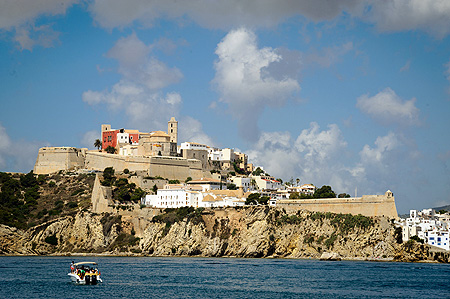
 La renovació i fortificació de la ciutat d’Eivissa, al segle XVI, formava part del pla de modernització de les defenses costaneres de la Mediterrània, impulsat per Carles I i Felip II, per mantenir i defendre els territoris de la Corona en una època de continus conflictes bèl·lics amb França i l’imperi otomà.
El projecte el va dissenyar l’enginyer Giovani Battista Calvi i les obres començaren a principi de 1555. En una primera fase es van construir sis baluards: Sant Jordi, Sant Jaume, Sant Pere, Sant Joan, Santa Tecla i Sant Bernat. Cap als anys setanta del segle XVI, el projecte original es va modificar per l’enginyer de la Corona, Jacobo Paleazzo Fratin, qui va projectar la construcció d’un nou baluard - el de Santa Llúcia- i l’ampliació del de Sant Joan; també es modificà l’accés principal que es va obrir en la cortina que uneix els baluards esmentats.
El nou sistema defensiu de la ciutat, proposat per Calvi, resseguia el perímetre de la fortificació existent, substituint les antigues tanques medievals per modern llenços i baluards. El projecte recollia els avanços de l’arquitectura militar desenvolupada a Itàlia durant la primera meitat del segle XVI, introduïts als territoris peninsulars per Benedetto de Rávena, que va estar al servei de Ferran el Catòlic i Carles I, i l’enginyer Giovanni Battistta Calvi, que treballà al servei de Felip II.
El procés de construcció de les murades i altres aspectes de les obres es coneixen per la documentació de l’època, sobretot per la correspondència dels enginyers amb la Corona, que són la font principal per conèixer la marxa de l’obra, marcada per la intervenció de dos enginyers, l’actuació dels quals permet diferenciar dues fases en el procés de construcció del recinte. La primera correspon al projecte de Calvi i la segona a la modificació del traçat realitzada per Fratin.
Les obres s’iniciaren el gener de 1555, sota la supervisió directa de Calvi, amb la construcció, per la banda de ponent, dels baluards de Sant Jordi i Sant Jaume. Quan l’enginyer abandonà l’illa, en març de 1555, els baluards de ponent estaven molt avançats i ja s’havia començat el de Sant Pere. A partir de llavors s’observà una ralentització de les obres, que avançaren poc a poc durant els anys següents. Es tenen notícies que al 1563 es feien els fonaments dels baluards de Sant Joan i Santa Tecla i, cinc anys després, es construïa la cortina entre ambdós. A les acaballes de dècada dels seixanta ja s’havia iniciat l’últim baluard de la traça de Calvi, el de Sant Bernat, enfront del Castell; anys després, es treballa al “Cos de Guardia” de la Porta de la Mar, que Calvi va projectar a l’extrem oest de la plaça de Vila.
Les obres de la fortificació donaren feina a un bon nombre de picapedrers i obrers locals. Entre els quals cal destacar al mestre Antoni Jaume, que per la seva habilitat fou instruït directament per l’enginyer per seguir endavant amb el projecte durant la seva absència. Antoni Jaume informava regularment de la marxa de les obres fins al 1562, que va anar a Perpinyà per trobar-se amb Calvi i llavors va desaparèixer. Fou rellevat pel mestre mallorquí Antoni Saura Cobo, que treballà en la construcció dels baluards de Sant Joan i Santa Tecla i la cortina d’entre ambdós.
L’any 1575 Fratín es va fer càrrec de les obres i es traslladà a Eivissa per inspeccionar la fortificació. Des del primer moment va observar que s’havia desenvolupat un barri extramurs dalt del Puig de Santa Llúcia i considerà oportú protegir-lo. Per això va haver de modificar la traça inicial, reorientant el baluard de Sant Joan i construint-ne un de nou, el de Santa Llúcia, i obrint, a la cortina que unia aquests dos baluards, la porta principal de la fortalesa: Porta del Mar o de ses Taules.
L’ampliació de la murada comportà l’expropiació de nous terrenys i per fer-se càrrec de l’obra es van contractar nous enginyers i mestres. El propi Fratín va instruir personalmen Juan Alonso Rubián que es desplaçà a l’illa per dur endavant el projecte, encara que va mantenir una freqüent correspondència amb Fratín informant-lo regularment de la marxa de les obres. En novembre de 1578 es rectificava el baluard de Sant Joan i es treballava en la construcció del revellí i mig cavaller devora el baluard de Santa Tecla. A més, l’enginyer va realitzar intervencions menors a les casamates i els baluards de Calvi, per tal de dotar-los de major seguretat. Alonso Rubián també manà obrir la porta del Soto Fosc, com es dedueix d’una carta seua on afirma “ha mandado abrir una calle para entrar cubiertos en la muralla …”. Durant la dècada dels anys 80 es construí el baluard de Santa Llúcia i la cortina on s’obrí la porta de la Mar, més coneguda com a Portal de ses Taules, la construcció de la qual es va iniciar cap al 1584.
La porta principal té un marcat caràcter monumental, flanquejada per dos estàtues romanes i, sobre l’arc d’entrada, una gran làpida commemorativa amb les armes de Felip II, l’escut de la ciutat i la data de 1585. Data que, això no obstant, no indica el final de la fortificació ja que durant l’última dècada del segle XVI varen continuar les obres, dirigides per un nou enginyer, Antoni Saura, fill d’un mestre que ja hi havia treballat amb Calvi. A les darreries del segle XVI, foren completant-se el remats dels baluards amb parapets i casamates, també s’acabaren les obres del Cos de Guàrdia, a l’entrada de la porta principal i, finalment, s’introduí una reforma al baluard de Sant Pere, afegint-li el cavaller de Sant Lluc, projectat per Antoni Saura, el dibuix del qual fou remès pel Governador al Monarca.